






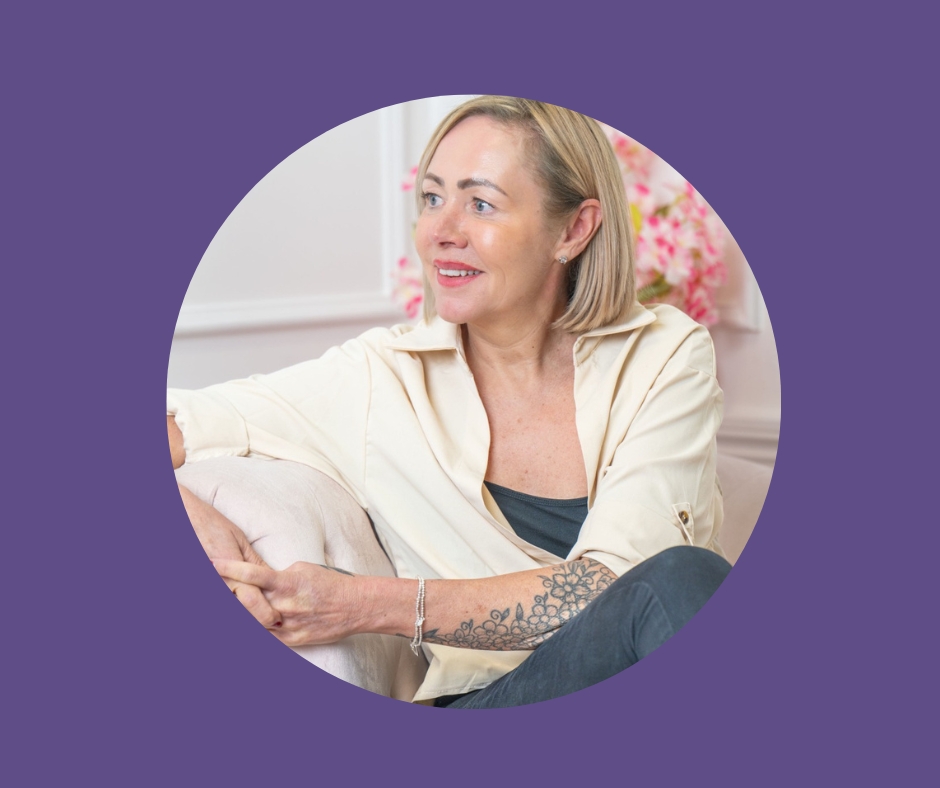
Deborah joined this year’s Spokesperson leadership programme because, despite her deep expertise and the success of her advocacy work, including the expansion of the proximity system, she seeks to refine her focus and build the confidence needed to serve as an articulate, impactful public spokesperson for her charity.
There’s a lot to tell. Resolute has three pillars to it.
Resolute is built on three pillars, starting with our home, the Lotus. It’s a navigation hub for domestic abuse survivors, bringing all services, advocacy, legal support, peer support, counselling, and EMDR therapy, under one roof. As a survivor myself, navigating the system alone was horrendous; we now see more survivors losing their lives to suicide than homicide. I wanted a space in the heart of Barnsley where survivors could feel supported as an entire family, rather than getting lost in a system that fails to protect them.
And then there’s the training side of it. So we have training packages as well. Our second pillar focuses on training. I deliver accredited training packages alongside Claire Throssell MBE to local authorities, law firms, and any organisation needing to better understand domestic abuse. We bespoke this training to ensure it drives real, institutional change.
So I’ve recently been successful in bringing the proximity system into reality and that is the biggest expansion of tagging in British history.
The third pillar is our campaigning. I have successfully brought the proximity system into reality, the largest expansion of tagging in British history. Perpetrators leaving prison are tagged, and survivors are equipped with devices or apps monitored by 24/7 live GPS. If the proximity is breached, it alerts a control room for a grade-one police response. This shifts the focus from victim-blaming to perpetrator accountability, reducing the need for refuge and saving lives.
Given that it’ll give them that security. So it is being implemented from June onwards on domestic abuse prisoners on release but it’s being piloted in October around three police forces because it would actually be the courts and the police that will set the proximity.
It’s currently being implemented for domestic abuse prisoners on release, with a pilot launching in October across three police forces. I pushed for South Yorkshire to be a pilot area and requested that the app, or the pilot, be named “Resolute,” a testament to a journey of surviving and thriving. Whether Resolute exists tomorrow or not, I know I have achieved this.
So I’m the founder of Resolute. And that was from my own lived experience of trying to not only when I was in my marriage with my abuser, with our abuser, but also after again trying to navigate the system, it was horrendous.
I founded Resolute from my own lived experience of trying to navigate a system that often seems designed to enable abuse. We provide strong advocates who stand side-by-side with survivors. Our biggest challenge is funding; with more resources, we could employ more advocates and drastically reduce abuse rates. Proximity tagging provides the deterrent we’ve been missing, and it’s the cornerstone of our mission to build a life free from domestic abuse.
It’s common sense to tackle domestic violence properly when you consider that domestic abuse costs this country 82 billion pounds per year.
It’s frustrating. Domestic abuse costs the UK £82 billion annually. If we tackled it properly, we could invest that money into prevention and technology. Apps like KULPA collect evidence directly for police and solicitors, yet we struggle to get institutions to invest. One domestic abuse homicide costs over a million pounds, not to mention the broader impact on mental health and addiction services. I became alcohol-dependent as a coping mechanism; that nearly killed me and left me with stage three liver disease. We have to make this everybody’s business.
It has to be a societal change to change that perception of what domestic abuse is,
We need education at every level: in school curriculums and mandatory in workplaces, just like health and safety standards. We must engage everyone, including men, to recognise the signs. I’m wary of government policies that punish young boys through perpetrator programmes, as this often just creates division. The solution is providing the tools to recognise abuse and holding individuals accountable for their behaviour, simple, preventative measures that seem to evade our government’s common sense.
More support from lived-experience is needed within the system.
I would love to see a Resolute Lotus in every town. When a survivor has lived experience, a peer connects with them in a way that others cannot. I know my own recovery was only possible because my caseworker shared that understanding. Organisations need to stop exploiting these voices. They set up steering groups without providing supervision or paying expenses. If they want to use our insight, they must pay for it. My passion is to make change on a scale larger than just a poster on a toilet door; it’s time to put money where their mouths are.
I want to learn how to focus better because I start talking about Resolute and then I go off onto one.
I joined this programme to refine my focus. With ADHD, I can ramble, so I need to stick to my three pillars. I want to articulate my message with more confidence. I hate public speaking, it makes me feel physically sick, but it’s the fire in my belly that keeps me going. When I talk about these injustices, I need to learn to tell my lived experience as a story, rather than letting the triggers resurface every time I step on a stage.
About the Author
Deborah Jones is the Founder and CEO of Resolute Women’s Support Services. Deborah is an expert by experience, campaigner, advocate and frontline leader who uses her lived experience to challenge systems, educate professionals and create meaningful support for women and children affected by domestic abuse.