





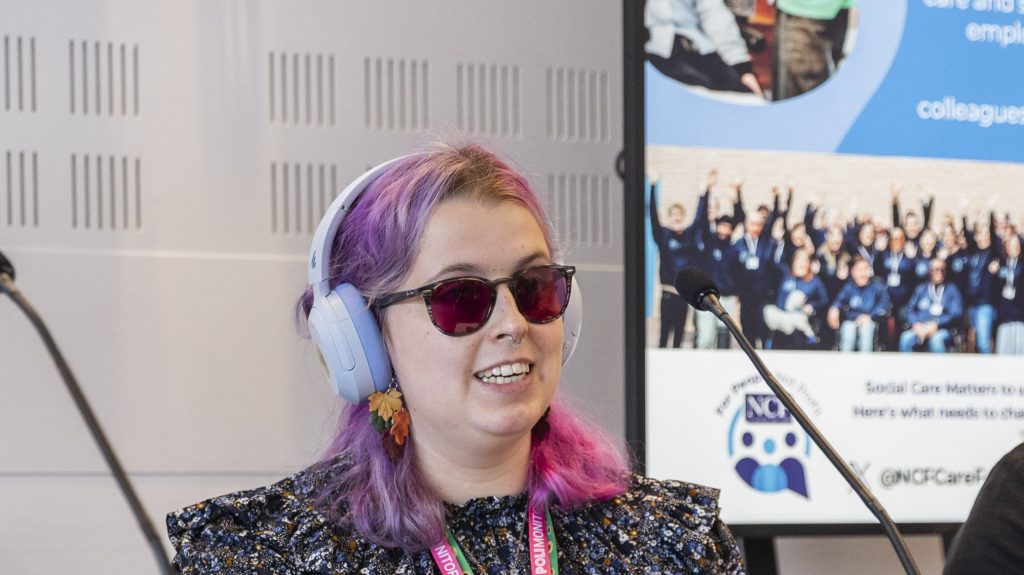
“Adult social care, when done right, is such a beautiful thing. It enables people to live their best lives. But unfortunately, it’s underfunded, underappreciated and undervalued by the government.
It’s also often misunderstood. When people hear ‘adult social care’, they think about elderly people with dementia. But that’s only one part of it. Adult social care covers a huge range of experiences.
Disabled people are tracked like an issue to be solved or a deficit on a spreadsheet. No. We’re human beings with feelings, wants and aspirations. It’s not that we don’t want to be part of society, it’s that society doesn’t enable us to be part of it.
Good social care enabled me to recover, stay well and start living again
I was sectioned, and the trauma I experienced in hospital left me unable to talk. I was mute for a couple of years. I was told I’d never be able to work, live independently, or stay out of hospital. I was told I’d become a revolving door patient. But with the right social care support, I’ve been able to do everything I was told I’d never be able to do.
This year marks 10 years since I was sectioned. I now live independently and have done for nearly a year. I work too, and I love it. There’s so much joy and freedom in my life where there wasn’t before. That’s what good social care enables.
Shared Lives care changed my life
I’m representing a charity called Shared Lives Plus. Shared Lives care is a unique model of adult social care where you live in a carer’s family home and you’re cared for in that family unit. The support is flexible too, from daycare opportunities and short breaks to long-term placements.
At the time, communication was incredibly difficult for me because I was mute and I found new people overwhelming. What worked well for me was that Shared Lives wasn’t faceless agency workers coming in and out of my life. I knew exactly who would be there every day because we all lived together and got to know each other. It’s much more person-centred and it’s one of the cheapest options too.
I spent almost eight years living that way. Through the support I received from Shared Lives, I gradually built my independence and started believing I could live on my own one day. Which I do. When social care is done well, it has the power to change people’s lives.
Disabled people should be allowed to live ordinary lives
Recently there’s been a lot of negativity towards disabled people, with claims that people are being over diagnosed or pretending to be ill. Disabled people can become an easy scapegoat and we’re bearing the brunt of that again now.
We should be able to live ordinary, boring lives like everyone else. But too often, disabled people are left begging for scraps and that just isn’t good enough.
When you’re disabled and accessing services, you constantly have to justify being able to do the bare minimum. Whether that’s getting dressed in the morning, leaving the house or moving in with a partner. Nobody else has to fight for those things.
I want people to see what disabled people bring
People don’t see what we can bring to society. My brother Josh has Down’s syndrome and his biggest dream is to stack shelves in a supermarket. He’d be ace at it. However, we haven’t managed to get him a job because people focus on what they think he can’t do instead of everything he can bring to a workplace. Because of that, employers are missing out and so is he.
Every three years, we have to pay for a doctor’s letter confirming he still has Down’s syndrome so the state can decide whether he should continue to receive benefits. It’s a lifelong disability. If we used a bit more common sense and a bit less bureaucracy, it would make people’s lives easier.
I’m excited to meet people who care about change
I’m really passionate about what I do. But sometimes it can feel like you’re having the same conversations over and over again. A lot of lived experience work can also feel tokenistic. That’s one of the reasons I signed up for the programme. I want to make sure I’m creating real change and also enabling other people to advocate for themselves.
I’m really looking forward to getting started on the programme. It’s scary, but exciting too. I enjoy meeting new people and learning from others who are equally passionate about making change happen.”
About the Author
Hope Lightowler was born and raised in Bradford and has three siblings with disabilities. She is also disabled, however this went undiagnosed until her adult years after becoming really unwell. She has lived and worked in adult social care, and has experienced it as a family member.
Adult social care is something she is incredibly passionate about, as well as disability rights. Her main goal is to make this world fairer and make sure it works better for people like her siblings. She uses my own personal experiences and advocates, so no one else has to go through what she has been through.