





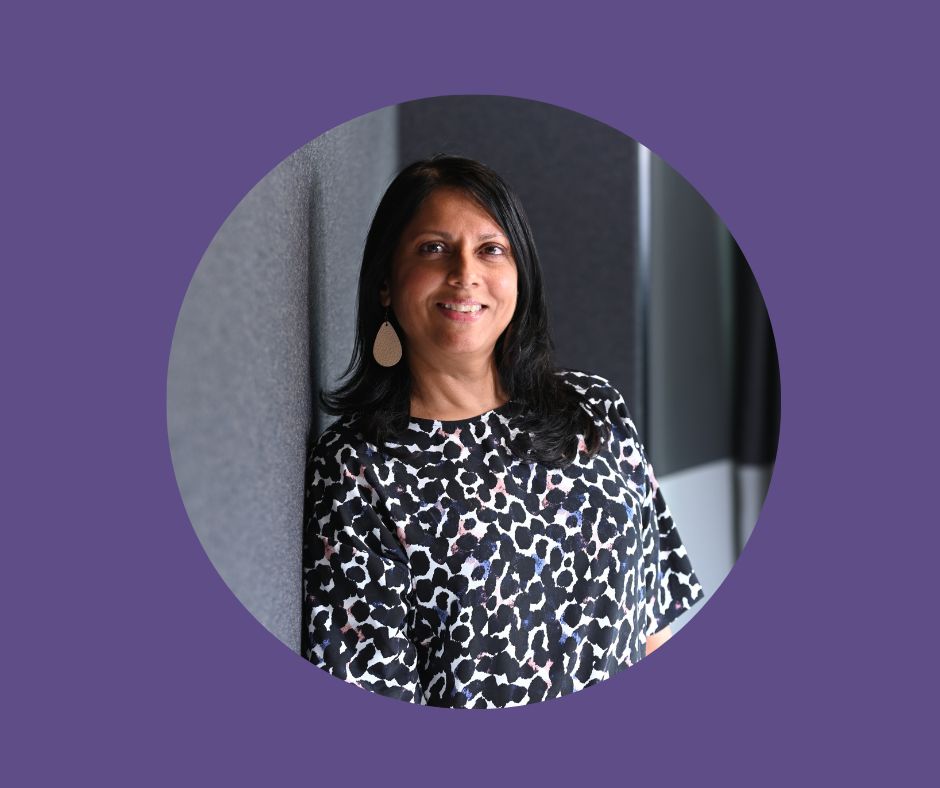
“Because I’m a brown woman and a first-generation immigrant, I’ve noticed disparities throughout my life. In how you’re treated at school and assumptions about your ability and attainment levels, through to university and employment.
My parents came from the Caribbean in the 1960s, and I consider myself working class. When you add class into the mix, there are lots of intersections that lead me to know and feel that I’ve experienced disparities in life. I was the first person in my family to go to university. I didn’t know anything about how it worked. There was so much to navigate growing up in that generation.
Throughout my career, which has spanned the corporate world, further education, and now the charity sector, I’ve been working towards a role where I can tackle these disparities and have a voice in saying that things are not equal. I’m coming towards the end of my 50s, so you can imagine how long I’ve been experiencing and talking about this. I wanted to be in a position where I could actually take some action.
The voices of people of colour are excluded from places of power
People of colour account for less than 15% of the UK population, yet it consistently surprises people when I note that 85% of this country is white. It underscores a stark reality: our voices remain excluded from places of power.
Much of the current anxiety around immigration and DEI feels driven by fear, echoing rhetoric from the States. But when you recognise that race is a manufactured social construct designed to serve a specific purpose centuries ago, you’re forced to ask: at what point do we finally dismantle it?
If it’s not your lived experience, it’s not on your radar
I remember speaking at a conference a couple of years ago when somebody said to me, “If everything you speak about as a charity was eradicated, you’d be out of a job.” And I said, “Yes, I’d be out of this job, but I’d be able to get one of the jobs that I currently can’t get.” I’d be more than happy for that to happen. But people are astonished when you explain that. They’re not even thinking about that.
One of the challenges our cause faces is that we often encounter the dismissive rhetoric that labels “wokeism” and EDI as nonsense. There is an inherent, often unspoken bias that assumes a white candidate is naturally the “best person for the job.” Conversely, when a person of colour is selected, there is a persistent misbelief that their appointment is merely the result of positive discrimination rather than their own merit. This scepticism toward the qualifications of professionals who are not white underscores the systemic hurdles we are working to dismantle.
We must acknowledge that these disparities are real
A significant part of the challenge is the frequent conflation of privilege with wealth. While there are many white working-class families who do not feel privileged, and yet the systemic advantages remain visible in employment.
For instance, a white working-class young man with few or no GCSEs can often still find a path into sectors like construction, manufacturing or engineering. In contrast, a young Black man with a university degree may still face significant barriers to entry in those same fields. This disparity is not about wealth, but about how different groups are recruited and perceived by industry.
True systemic change can only occur when those in positions of power, in government and across corporate leadership, acknowledge that these disparities are real. Dismissing these issues prevents progress.
We can’t rely on sweeping, generic plans that fail to address the root causes of inequality. Instead, we need targeted, intentional support programmes that specifically address employer bias and the disproportionate impact of unemployment on young people of South Asian and Black heritage.
If I can change mindsets, then it will all have been worth it
Sometimes the best way to create change is to bring people from different backgrounds together and actually talk. Through our involvement in the Alliance for Racial Justice, a collective of race equity organisations, we demonstrate how groups are uniting to actively counter the growing surge of anti-EDI messaging.
If you’re on social media, you can easily just get caught up in a bubble that agrees with what you agree with. And that isn’t necessarily always how you move forward. You do have to tackle people who are not on the same page as you.
I don’t post much on social media about racism because I don’t want to deal with the backlash. For example, the trolling that Black MPs get is horrendous. I don’t want to open myself up to the horror that is racist trolling. It sometimes feels like a real, visceral hatred. It makes my job harder, but I think it also makes us all more resilient.
I try not to let it take over my whole being because those stories are so traumatic
The only way for me to cope with what I hear through my work is to almost hear it and then step aside. I’m really passionate about the work that I do, but it’s hard not to feel for the young people I meet who are really struggling to get a job. I have to distance myself from some of the pain and the trauma.
I listen to LBC a lot. In the future, I’d love to be their go-to spokesperson on Black youth or South Asian youth unemployment. That’s my aspiration for taking part in the Sounddelivery Media programme.”
Find out more about Action For Race Equality via https://actionforraceequality.org.uk/
About the Author
Indra is currently Deputy Chief Executive at Action for Race Equality, where she has worked for the past twelve years. During this time, she played a key role in helping the organisation double in size, in both turnover and staffing. She has championed race equality for over fifteen years, leading both large and small programmes to close the disparity gap between Global Majority communities and others, with a particular impact on youth employment.